Intermittent fasting vs calorie counting: which works better?
A review of 99 trials found intermittent fasting and calorie counting lose about the same weight. Here's what the research says and how to pick the one you'll keep.
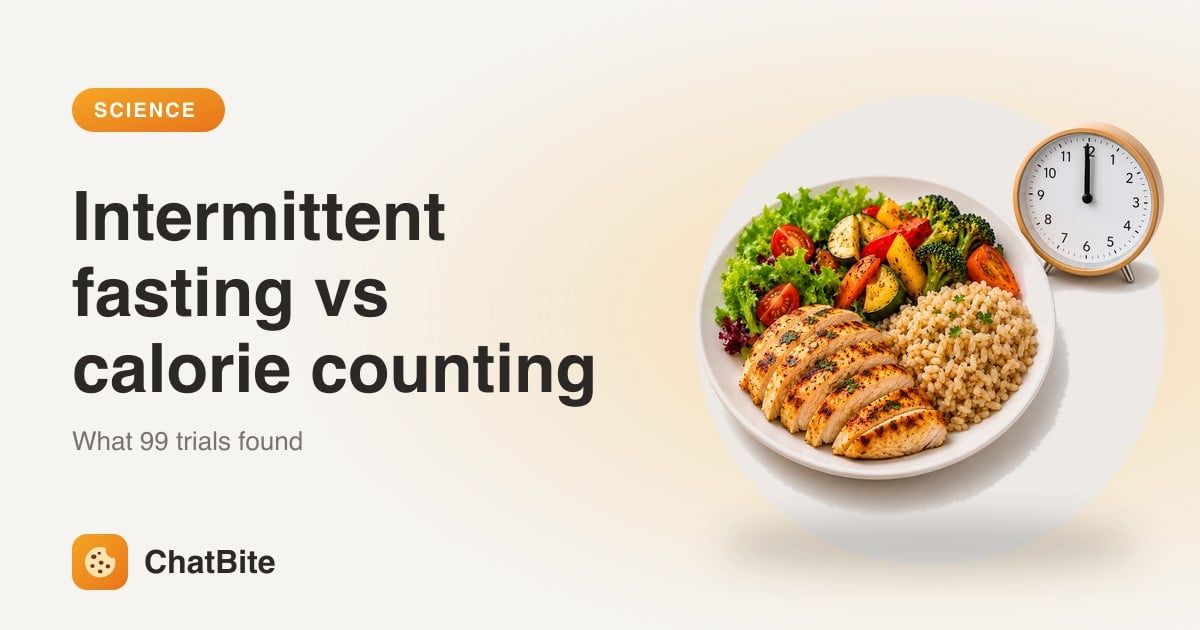
For weight loss, intermittent fasting and calorie counting work about equally well. The largest review so far, published in The BMJ in 2025, pooled 99 randomised trials with more than 6,500 adults and found both approaches led to similar weight loss, with no method clearly ahead. This post explains what that research found, why the results look the same, and how to choose the approach you'll actually stick with.
What is the difference between intermittent fasting and calorie counting?
Calorie counting, which researchers call continuous calorie restriction, means eating a bit less than you burn every day, usually about 500 kcal below your maintenance level. You can eat at any time; you just keep an eye on the total.
Intermittent fasting limits when you eat rather than how much. The three common styles are below. None of them asks you to count, but all of them tend to make you eat less.
| Style | How it works | Example |
|---|---|---|
| Time-restricted eating (16:8) | Eat within a daily window, fast the rest | Eat between 12 pm and 8 pm |
| 5:2 | Eat normally 5 days, very little on 2 | About 500–600 kcal on Monday and Thursday |
| Alternate-day fasting | Fast or eat very little every other day | About 500 kcal on fasting days |
Intermittent fasting vs calorie counting: what does the research say?
The 2025 BMJ network meta-analysis compared every strategy with each other and with an unrestricted diet. All of them, fasting and calorie counting alike, led to modest weight loss compared with eating freely. Alternate-day fasting came out slightly ahead of daily calorie restriction, by about 1.3 kg, but the authors noted that this was below the 2 kg they consider a meaningful difference for people with obesity. The certainty of the evidence was low to moderate for most outcomes, and many trials were small and short.
Two well-known trials point the same way. In a 12-month trial in China, published in the New England Journal of Medicine in 2022, people who ate within an 8-hour window and also cut calories lost about 8 kg, while those who cut the same calories with no time limit lost about 6.3 kg. The difference was not statistically significant. In the 2020 TREAT trial in the United States, a 16:8 schedule without any other guidance produced very little weight loss, less than a kilogram, which was not meaningfully different from the control group.
Why do they give the same results?
Because both work through the same thing: eating fewer calories than you burn. Experts commenting on the BMJ review made exactly this point: intermittent fasting seems to work mainly by helping people eat less in total. A shorter eating window removes late-night snacks and a meal or two of grazing, and that is where most of the deficit comes from.
It also explains why fasting can stall. If the meals inside your window grow bigger, the deficit disappears. A 16:8 day of a 900 kcal lunch, a 400 kcal snack and a 1,100 kcal dinner adds up to 2,400 kcal, which may be maintenance or more for many people, no matter how long the fast was.
Do calories still count when intermittent fasting?
Yes. Timing doesn't cancel out quantity. The NEJM trial is a good illustration: when calories were matched, adding an eating window did not make a significant difference. Fasting can be a useful structure, but what you eat during the window still decides the outcome.
Protein matters on either approach. When you eat in a deficit, getting enough protein, roughly 1.2 to 1.6 g per kg of body weight a day according to much of the research on weight loss, helps protect muscle and keeps you fuller. With fewer meals in a short window, that can be harder to fit in, so plan a protein source for each meal.
Which one should you choose?
Pick the one that fits your life, because the best diet in these studies was the one people kept doing. A few honest signals can help.
| Intermittent fasting may suit you if… | Calorie counting may suit you if… |
|---|---|
| You're rarely hungry in the morning | You get shaky or irritable when you skip meals |
| You like simple rules over numbers | You like seeing exactly where calories come from |
| Evening snacking is your main problem | Your schedule changes a lot (shifts, travel) |
| You eat most meals at home | You eat out or share family meals often |
Many people combine them. Take Maya, who eats between noon and 8 pm and also notes what she eats. Her lunch of a chicken shawarma wrap with salad comes to around 600 kcal, an afternoon Greek yogurt with berries adds about 150, and a dinner of salmon, rice and greens about 650. That's about 1,400 kcal, a clear deficit for her, and she can see it rather than guess.
Fasting is not for everyone. If you are pregnant or breastfeeding, have diabetes or take medication that affects blood sugar, or have a history of an eating disorder, talk to a doctor or registered dietitian before trying it.
How to do either one without a spreadsheet
The hard part of calorie counting is the logging, and the hard part of fasting is knowing whether the meals in your window are actually adding up to a deficit. A quick record of what you ate solves both.
ChatBite is an AI calorie and protein coach that works inside WhatsApp and Telegram: you send a photo, a few words or a voice note, and it logs your meal and tracks your day. Each meal comes back as a Logged card with calories, protein, carbs and fat and a progress bar against your target, so you can see whether today's window landed in a deficit. Ask “how am I doing today?” at any time, and a weekly summary shows the trend.
Is intermittent fasting better than calorie counting for weight loss?
Not clearly. A 2025 BMJ review of 99 trials found intermittent fasting and daily calorie restriction led to similar weight loss. Alternate-day fasting had a small edge of about 1.3 kg, which the authors judged too small to matter clinically.
Can you lose weight with 16:8 fasting without counting calories?
Some people do, because a shorter eating window often means fewer snacks. But in the 2020 TREAT trial, 16:8 on its own produced less than a kilogram of weight loss, so it works only if your total intake actually drops.
Do calories count during the eating window?
Yes. Weight loss still depends on eating less than you burn. Large meals inside the window can cancel out the fast.
Does intermittent fasting cause muscle loss?
Any diet that loses weight can lose some muscle. Eating enough protein at each meal and doing strength training are the best ways to protect it, whichever approach you use.
Who should avoid intermittent fasting?
People who are pregnant or breastfeeding, have diabetes or take blood sugar medication, or have a history of eating disorders should speak to a doctor or registered dietitian first.
Sources: The BMJ (Semnani-Azad et al., 2025, network meta-analysis of intermittent fasting and calorie restriction); New England Journal of Medicine (Liu et al., 2022); JAMA Internal Medicine (Lowe et al., 2020, TREAT trial); Science Media Centre expert reactions; Harvard T.H. Chan School of Public Health, The Nutrition Source.
Values are typical estimates for home-style food and vary by recipe and portion. This is general information, not medical advice.
Put it into practice
Snap your next meal and ChatBite does the maths. Free for 7 days, no card needed.